Autor: esteban.sanchez.mateus@gmail.com

  • Unlocking the secrets of casino success Strategies for every player

    Unlocking the secrets of casino success Strategies for every player

    Στρατηγικές για επιτυχία στα καζίνο

    Η επιτυχία στα καζίνο δεν είναι μόνο θέμα τύχης, αλλά και καλή στρατηγική. Οι παίκτες πρέπει να αναπτύξουν μια στρατηγική που να τους επιτρέπει να διαχειρίζονται σωστά τα κεφάλαιά τους και να έχουν έναν καθαρό στόχο για κάθε παιχνίδι. Μια από τις βασικές στρατηγικές είναι η καθορισμένη επιλογή παιχνιδιών, όπου οι παίκτες επιλέγουν στοιχηματικεσ στην ελλαδα με καλύτερες αποδόσεις και πιθανότητες νίκης.

    Επιπλέον, η καλή διαχείριση του προϋπολογισμού είναι κρίσιμη. Οι παίκτες πρέπει να ορίσουν ένα ποσό χρημάτων που είναι διατεθειμένοι να χάσουν και να μην ξεπερνούν αυτό το όριο. Η σωστή προετοιμασία μπορεί να αποτρέψει τις απώλειες και να ενισχύσει την εμπειρία παιχνιδιού τους.

    Η σημασία της ψυχολογίας στο παιχνίδι

    Η ψυχολογία παίζει καθοριστικό ρόλο στην επιτυχία ενός παίκτη στο καζίνο. Οι συναισθηματικές καταστάσεις όπως ο ενθουσιασμός και η απογοήτευση μπορεί να επηρεάσουν την απόφαση του παίκτη. Είναι σημαντικό οι παίκτες να διατηρούν την αυτοσυγκέντρωσή τους και να μην επιτρέπουν στα συναισθήματα να επηρεάσουν τις επιλογές τους.

    Η ικανότητα να παραμένει κανείς ήρεμος υπό πίεση μπορεί να είναι καθοριστική. Οι καλοί παίκτες ξέρουν πότε να αποσυρθούν και να κάνουν ένα διάλειμμα, αν αισθάνονται ότι χάνουν τον έλεγχο. Η καλή ψυχολογία συμβάλλει στην καλύτερη απόφαση και στην αύξηση της πιθανότητας νίκης.

    Ενημέρωση για τους κανόνες και στρατηγικές παιχνιδιού

    Η γνώση των κανόνων κάθε παιχνιδιού είναι απαραίτητη για την επιτυχία. Οι παίκτες που γνωρίζουν τις λεπτομέρειες και τις στρατηγικές του παιχνιδιού έχουν περισσότερες πιθανότητες να κερδίσουν. Για παράδειγμα, στο πόκερ, η κατανόηση των χεριών και των στοιχημάτων είναι κρίσιμη για να επικρατήσουν έναντι των αντιπάλων.

    Επιπλέον, οι παίκτες θα πρέπει να εξετάζουν συνεχώς τις στρατηγικές τους και να προσαρμόζονται ανάλογα με τις συνθήκες του παιχνιδιού. Η ευελιξία και η προσαρμοστικότητα είναι θεμελιώδεις για να διατηρήσουν το πλεονέκτημα κατά τη διάρκεια του παιχνιδιού.

    Η επιλογή του σωστού καζίνο

    Η επιλογή του σωστού καζίνο μπορεί να κάνει τη διαφορά στην εμπειρία του παίκτη. Οι παίκτες πρέπει να επιλέγουν καζίνο που προσφέρουν διαφανείς κανόνες, δίκαιες αποδόσεις και καλές προσφορές. Η έρευνα για το καζίνο πριν από την εγγραφή είναι σημαντική για να διασφαλίσουν ότι παίζουν σε ένα αξιόπιστο περιβάλλον.

    Επιπλέον, η αναζήτηση κριτικών και συστάσεων από άλλους παίκτες μπορεί να είναι εξαιρετικά χρήσιμη. Ένα καλό καζίνο προσφέρει επίσης υποστήριξη πελατών, ώστε οι παίκτες να μπορούν να λύσουν οποιαδήποτε ζητήματα που προκύψουν κατά τη διάρκεια του παιχνιδιού.

    Πληροφορίες για την ιστοσελίδα

    Η ιστοσελίδα μας είναι αφιερωμένη στην παροχή πολύτιμων πληροφοριών και συμβουλών για τους παίκτες στα καζίνο. Προσφέρουμε οδηγούς, στρατηγικές και ειδήσεις που θα βοηθήσουν τους παίκτες να εξελιχθούν και να αποκτήσουν μια καλύτερη κατανόηση του κόσμου των καζίνο.

    Επισκεφθείτε την ιστοσελίδα μας για περισσότερες λεπτομέρειες και να γίνετε μέρος της κοινότητας των παικτών που μοιράζονται τις γνώσεις και τις εμπειρίες τους για να πετύχουν στον κόσμο των καζίνο.

  • Unlocking the secrets of successful casino strategies

    Unlocking the secrets of successful casino strategies

    Understanding the Psychology of Betting

    One of the fundamental aspects of successful casino strategies lies in understanding the psychology of betting. Gamblers are often driven by emotions such as excitement and anticipation, which can cloud their judgment. By recognizing how these emotions influence decision-making, players can develop a more disciplined approach to their gambling activities, enabling them to make more rational choices and better manage their bankroll. Additionally, those seeking to enhance their gaming experience should consider the best uk non gamstop casinos 2026, as they can offer unique advantages and greater flexibility in play.

    Additionally, successful gamblers often study the behaviors and tendencies of other players. Observing how fellow gamblers react in different situations can provide valuable insights into the dynamics of the game, allowing for more strategic betting. This form of psychological analysis can lead to an improved ability to anticipate opponents’ actions, particularly in games that involve interpersonal competition, like poker.

    Bankroll Management Techniques

    Effective bankroll management is crucial for any serious gambler looking to implement successful casino strategies. This involves setting a budget for gambling activities and sticking to it to minimize the risk of significant losses. A well-defined bankroll allows players to enjoy their gaming experience without the stress of overspending, ultimately leading to a more enjoyable and sustainable practice.

    Moreover, employing a structured approach to bankroll allocation can enhance a player’s potential for long-term success. For instance, some players allocate a specific percentage of their bankroll for each gaming session, ensuring they never gamble more than they can afford to lose. This protective measure can prevent the emotional highs and lows often associated with gambling and help maintain a balance between thrill and responsibility.

    Choosing the Right Games

    Selecting the appropriate games to play is another vital element of successful casino strategies. Different games come with varying odds and house advantages, which can significantly impact a player’s potential for success. Understanding these differences allows gamblers to make informed decisions about where to invest their time and money, favoring games that offer better odds of winning.

    Additionally, some games require skill and strategy, such as blackjack and poker, while others rely purely on chance, such as slot machines. By focusing on skill-based games, players can leverage their knowledge and abilities to improve their chances of winning. This strategic selection process not only enhances the gaming experience but also increases the likelihood of achieving positive financial outcomes over time.

    Utilizing Betting Systems

    Betting systems can serve as an extra layer of strategy for players looking to optimize their casino experience. These systems—ranging from the Martingale strategy to the Fibonacci system—aim to provide structured approaches to betting, helping players manage their wagers based on previous outcomes. By following a systematic approach, players may find it easier to maintain their bankroll and make considered decisions throughout their gaming sessions.

    However, it’s essential for players to understand that while these systems can offer guidance, they are not foolproof. No betting system can change the inherent odds of the games, and players should remain cautious about over-relying on them. The key to success lies in combining these systems with solid bankroll management and a deep understanding of the games being played.

    Resources for Informed Gambling

    For those looking to delve deeper into the world of gambling strategies, various resources are available to provide valuable insights. Websites dedicated to gambling education offer articles, tutorials, and community forums for players to share experiences and strategies. Engaging with these resources can enhance a player’s understanding and implementation of effective gambling strategies.

    Furthermore, staying updated on the latest trends and changes in the gaming industry is crucial for any serious gambler. Knowledge of emerging games, evolving regulations, and innovative strategies can empower players to make informed decisions, significantly improving their chances of long-term success and enjoyment in the casino.

  • Coronavirus disease 2019

    Coronavirus disease 2019

    COVID-19 is a contagious disease caused by the coronavirus SARS-CoV-2. In January 2020, the disease spread worldwide, resulting in the COVID-19 pandemic.

    The symptoms of COVID‑19 can vary but often include fever,[7] fatigue, cough, breathing difficulties, loss of smell, and loss of taste.[8][9][10] Symptoms may begin one to fourteen days after exposure to the virus. At least a third of people who are infected do not develop noticeable symptoms.[11][12] Of those who develop symptoms noticeable enough to be classified as patients, most (81%) develop mild to moderate symptoms (up to mild pneumonia), while 14% develop severe symptoms (dyspnea, hypoxia, or more than 50% lung involvement on imaging), and 5% develop critical symptoms (respiratory failure, shock, or multiorgan dysfunction).[13] Older people have a higher risk of developing severe symptoms. Some complications result in death. Some people continue to experience a range of effects (long COVID) for months or years after infection, and damage to organs has been observed.[14] Multi-year studies on the long-term effects are ongoing.[15]

    COVID‑19 transmission occurs when infectious particles are breathed in or come into contact with the eyes, nose, or mouth. The risk is highest when people are in close proximity, but small airborne particles containing the virus can remain suspended in the air and travel over longer distances, particularly indoors. Transmission can also occur when people touch their eyes, nose, or mouth after touching surfaces or objects that have been contaminated by the virus. People remain contagious for up to 20 days and can spread the virus even if they do not develop symptoms.[16]

    Testing methods for COVID-19 to detect the virus’s nucleic acid include real-time reverse transcription polymerase chain reaction (RT‑PCR),[17][18] transcription-mediated amplification,[17][18][19] and reverse transcription loop-mediated isothermal amplification (RT‑LAMP)[17][18] from a nasopharyngeal swab.[20]

    Several COVID-19 vaccines have been approved and distributed in various countries, many of which have initiated mass vaccination campaigns. Other preventive measures include physical or social distancing, quarantining, ventilation of indoor spaces, use of face masks or coverings in public, covering coughs and sneezes, hand washing, and keeping unwashed hands away from the face. While drugs have been developed to inhibit the virus, the primary treatment is still symptomatic, managing the disease through supportive care, isolation, and experimental measures.

  • Coronavirus disease 2019

    Coronavirus disease 2019

    COVID-19 is a contagious disease caused by the coronavirus SARS-CoV-2. In January 2020, the disease spread worldwide, resulting in the COVID-19 pandemic.

    The symptoms of COVID‑19 can vary but often include fever,[7] fatigue, cough, breathing difficulties, loss of smell, and loss of taste.[8][9][10] Symptoms may begin one to fourteen days after exposure to the virus. At least a third of people who are infected do not develop noticeable symptoms.[11][12] Of those who develop symptoms noticeable enough to be classified as patients, most (81%) develop mild to moderate symptoms (up to mild pneumonia), while 14% develop severe symptoms (dyspnea, hypoxia, or more than 50% lung involvement on imaging), and 5% develop critical symptoms (respiratory failure, shock, or multiorgan dysfunction).[13] Older people have a higher risk of developing severe symptoms. Some complications result in death. Some people continue to experience a range of effects (long COVID) for months or years after infection, and damage to organs has been observed.[14] Multi-year studies on the long-term effects are ongoing.[15]

    COVID‑19 transmission occurs when infectious particles are breathed in or come into contact with the eyes, nose, or mouth. The risk is highest when people are in close proximity, but small airborne particles containing the virus can remain suspended in the air and travel over longer distances, particularly indoors. Transmission can also occur when people touch their eyes, nose, or mouth after touching surfaces or objects that have been contaminated by the virus. People remain contagious for up to 20 days and can spread the virus even if they do not develop symptoms.[16]

    Testing methods for COVID-19 to detect the virus’s nucleic acid include real-time reverse transcription polymerase chain reaction (RT‑PCR),[17][18] transcription-mediated amplification,[17][18][19] and reverse transcription loop-mediated isothermal amplification (RT‑LAMP)[17][18] from a nasopharyngeal swab.[20]

    Several COVID-19 vaccines have been approved and distributed in various countries, many of which have initiated mass vaccination campaigns. Other preventive measures include physical or social distancing, quarantining, ventilation of indoor spaces, use of face masks or coverings in public, covering coughs and sneezes, hand washing, and keeping unwashed hands away from the face. While drugs have been developed to inhibit the virus, the primary treatment is still symptomatic, managing the disease through supportive care, isolation, and experimental measures.

  • Programa de estímulos Fiscales para el ejercicio 2026

    Programa de estímulos Fiscales para el ejercicio 2026

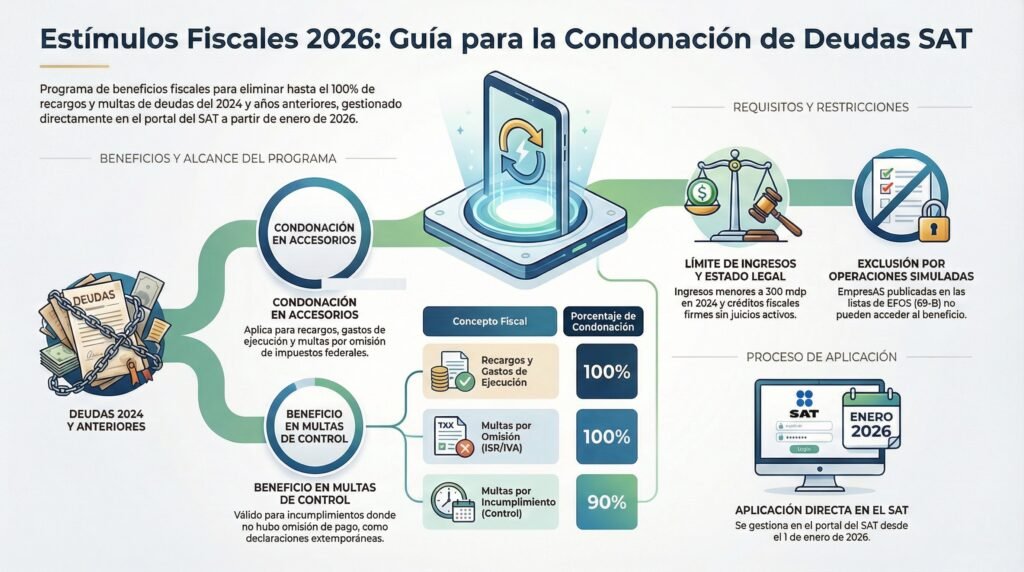
    Este programa permite obtener hasta un 100% de condonación en multas, recargos y gastos de ejecución ante el SAT en México.

    1. ¿Qué conceptos se pueden condonar al 100%?

    El estímulo está diseñado para limpiar adeudos de los ejercicios 2024 y anteriores, cubriendo lo siguiente:

    • Recargos: Aplica para contribuciones federales propias (como ISR), retenciones (nómina) o impuestos trasladados (IVA).
    • Gastos de ejecución: Se eliminan los cobros adicionales que la autoridad genera al intentar realizar el cobro forzoso de un crédito fiscal.
    • Multas por omisión: Aquellas multas que se determinaron junto con el pago de impuestos omitidos.
    • Multas de comercio exterior: Determinadas tanto por el SAT como por la Agencia Nacional de Aduanas de México.

    Nota: Si la multa es por incumplimiento de obligaciones donde no hubo omisión de pago (como no presentar una declaración a tiempo), la condonación es del 90%.

    2. Requisitos principales

    • Toque de ingresos: Solo pueden aplicar contribuyentes que no hayan superado los 300 millones de pesos de ingresos en el ejercicio 2024.
    • Estado del crédito: Debe tratarse de créditos fiscales “firmes”, es decir, aquellos que ya no pueden ser impugnados.
    • Situación legal: Si el contribuyente tiene un juicio o recurso de defensa activo, deberá desistirse del mismo para poder recibir el beneficio.

    3. ¿Quiénes NO pueden aplicar?

    El beneficio no será otorgado en los siguientes casos:

    • Personas con una sentencia condenatoria firme por delitos fiscales.
    • Contribuyentes publicados en las listas de operaciones simuladas (EFOS) bajo los artículos 69-B y 69-bis.
    • Multas que no sean de carácter federal (como multas de tránsito administrativo que el SAT solo gestiona para su cobro).

    4. Procedimiento de aplicación

    El proceso se gestiona directamente en el portal del SAT a partir del 1 de enero de 2026. Los contribuyentes deben ingresar al apartado de declaraciones o autocorrección para generar el formato de pago con el descuento ya aplicado. Al realizar la solicitud, se suspenden los procesos de cobro coactivo y no es necesario dejar una garantía de pago.

  • Banderas Rojas para el SAT

    Banderas Rojas para el SAT

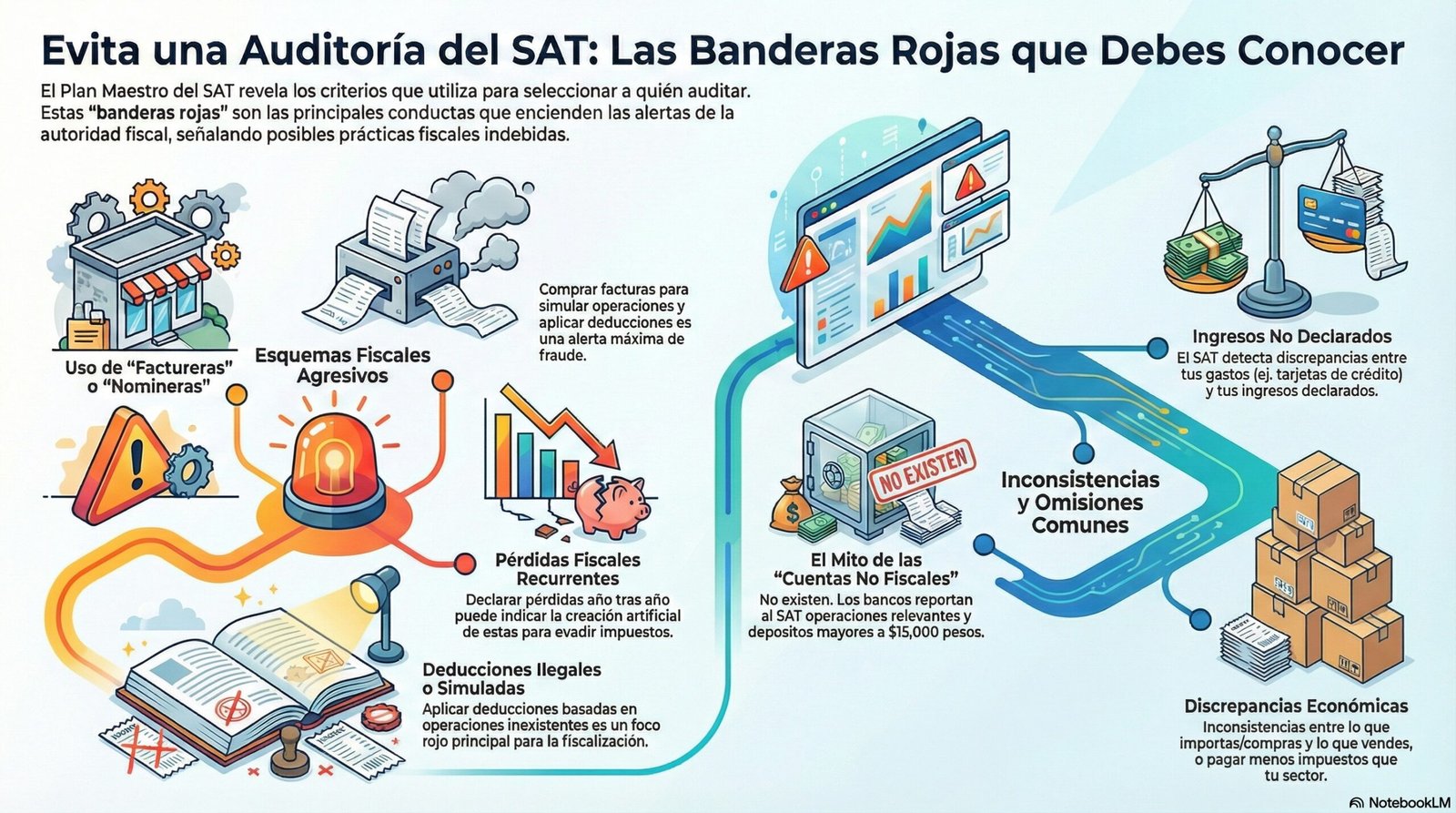
     “Las BANDERAS ROJAS que usa el SAT para Auditarte Plan Maestro Fiscal”, explica los criterios que utiliza el Servicio de Administración Tributaria (SAT) en México para seleccionar a los contribuyentes que serán sujetos a revisiones y auditorías fiscales.

    Baja tasa efectiva de impuestos: Pagar un porcentaje de impuesto menor al promedio del sector económico al que pertenece el contribuyente, lo que activa revisiones de “razón de negocios” y precios de transferencia.

    Operaciones con factureras o nomineras: El SAT se enfoca en detectar planeaciones fiscales agresivas donde se simulan operaciones mediante la compra de facturas para deducir gastos o acreditar IVA.

    Pérdidas fiscales recurrentes: Se audita a empresas que presentan pérdidas constantes, especialmente aquellas que utilizan esquemas para generar pérdidas artificiales y aplicarlas en ejercicios posteriores.

    Deducciones ilegales o simuladas: El uso de deducciones sin sustento real es un punto de alerta directa para la autoridad.

    Ingresos no declarados y discrepancia fiscal: Se advierte que las “cuentas no fiscales” no existen para la tecnología actual del SAT. También menciona el peligro de pagar tarjetas de crédito con efectivo sin haber declarado previamente el origen de ese dinero.

    Abuso de estímulos fiscales: El uso indebido de beneficios o incentivos otorgados por la ley.

    Inconsistencias entre compras y ventas: El SAT revisa que exista una lógica entre lo que una empresa importa o adquiere y lo que finalmente vende, vigilando de cerca el control de inventarios.

    Importaciones por debajo del valor de mercado: Introducir productos al país declarando precios inferiores a los reales para pagar menos impuestos.

    Omisión en el pago de retenciones: No entregar al fisco el impuesto retenido a los empleados (nómina).

    Solicitud de devoluciones improcedentes: Intentar obtener devoluciones de impuestos basadas en facturas falsas o datos inexistentes.